Auto insurance in Massachusetts is not just a bill to pay. It is a smart financial shield that can protect your car, your savings, and your peace of mind. Most drivers pay anywhere from about $600 to $2,400 per year depending on age, driving record, location, vehicle, and coverage level, which means the right policy can save you hundreds without sacrificing protection.
If you want the best value, look beyond the first low quote you see. In Massachusetts, minimum coverage may cost far less than full coverage, but cheaper today can feel expensive after one serious accident. The real win comes from matching strong protection with discounts, smart comparison shopping, and a policy built for the way you actually drive.






Average cost of auto insurance in Massachusetts
Auto insurance in Massachusetts often lands in a middle ground: not the cheapest in the country, but far from the most expensive. For many drivers, that means rates that feel manageable at first glance, yet can shift quickly depending on the type of policy you buy.
Across the state, drivers commonly see minimum coverage premiums around $35 to $70 per month, or roughly $420 to $840 per year. A step up to liability-only coverage often falls near $45 to $90 monthly, while full coverage usually sits closer to $110 to $220 per month, or about $1,320 to $2,640 annually. These are broad statewide averages, but they give you a practical starting point when estimating what Massachusetts car insurance may cost.
What Different Price Bands Really Look Like
Think of Massachusetts premiums in tiers rather than one fixed number. That approach makes it easier to spot where your quote fits and whether it looks competitive for the market. In general, minimum coverage is the lowest-priced option, liability-only coverage adds a little more protection with a modest price bump, and full coverage costs the most because it also includes collision and comprehensive protection.
Here is a simple way to read the usual premium bands:
- Budget tier: about $35 to $60 per month or $420 to $720 per year, often seen with basic minimum coverage.
- Moderate tier: about $60 to $100 per month or $720 to $1,200 per year, common for stronger liability-only policies.
- Elevated tier: about $110 to $160 per month or $1,320 to $1,920 per year, typical for lower-cost full coverage.
- High tier: about $160 to $220+ per month or $1,920 to $2,640+ per year, often full coverage with broader protection or higher-risk pricing.
| Driver profile | Monthly estimate | Annual estimate | Cost level |
|---|---|---|---|
| Basic state-minimum shopper | $35-$60 | $420-$720 | Low |
| Liability-only policyholder | $45-$90 | $540-$1,080 | Moderate |
| Typical full coverage driver | $110-$160 | $1,320-$1,920 | Elevated |
| Higher-priced full coverage buyer | $160-$220+ | $1,920-$2,640+ | High |
The biggest statewide price gap usually appears between minimum coverage and full coverage. Minimum coverage is designed to meet legal requirements at the lowest possible cost, while liability-only coverage may raise limits and improve protection without reaching full coverage pricing. Full coverage stands apart because it protects your own vehicle as well, so the average premium is typically much higher even for otherwise standard drivers.
Quick insight: Massachusetts premiums can differ from national averages because the state has dense traffic corridors, higher repair and medical costs in some areas, and its own insurance rules and rating environment, all of which can push prices up or keep them more stable depending on the policy type.
Main factors that affect insurance prices
In Massachusetts, two drivers can own similar cars and still see very different premiums. Insurers price policies by measuring risk, repair costs, and claim likelihood, so small details can move your rate more than you expect.
The biggest pricing drivers usually include your age, driving history, ZIP code, vehicle type, annual mileage, and the amount of coverage you buy. In some cases, insurers also weigh credit-related or insurance-based factors where legally applicable, but Massachusetts relies more heavily on driving record, garaging location, and vehicle-specific risk. That means where you live and how you drive often matter more than shoppers assume.
What insurers quietly score behind the scenes
Age and experience often raise rates for younger drivers because they are statistically more likely to file claims. Driving history is one of the strongest price levers: a clean record can unlock noticeably lower premiums, while accidents, tickets, and recent claims can push rates upward fast. ZIP code matters because dense areas tend to have more traffic, theft exposure, and costly repairs. Vehicle type also changes pricing, since luxury models, sports cars, and vehicles with expensive parts usually cost more to insure than modest sedans or SUVs. Finally, mileage and coverage selection affect how much risk you present and how much protection the insurer may have to pay for after a loss.
Here is a quick look at how these factors can influence what Massachusetts drivers pay:
| Factor | Why it matters | Possible price impact | Example scenario |
|---|---|---|---|
| Age | Less driving experience often means higher claim risk | High for teens and young adults | A 19-year-old usually pays much more than a 40-year-old with the same car |
| Driving record | Tickets and crashes signal higher future claim probability | Often one of the largest increases | A recent at-fault accident can raise rates for several policy terms |
| ZIP code | Traffic density, theft rates, and repair costs vary by area | Moderate to substantial | Boston-area garaging may cost more than a quieter suburb |
| Vehicle and coverage | Expensive cars and broader protection cost more to insure | Moderate to high | Adding collision and comprehensive on a newer SUV increases premium |
Driving history deserves special attention because it can reshape premium ranges very quickly. Even one event on your record may change how insurers classify your risk.
- Clean record: Usually qualifies for the best pricing tier and steadier renewal offers.
- Speeding ticket: Often triggers a moderate increase, especially if it is recent or paired with other violations.
- At-fault accident: Commonly causes a larger jump than a single ticket because it shows real claim costs.
- Multiple claims: Can push rates higher again, particularly if claims are close together in time.
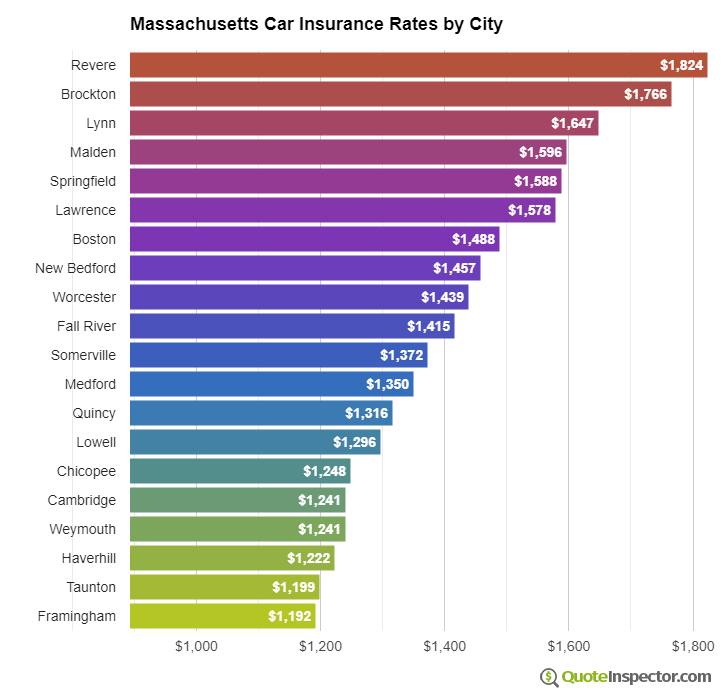
Location inside Massachusetts can also change the math. Urban drivers in places like Boston, Worcester, or Springfield may face higher premiums because insurers expect more congestion, more frequent fender-benders, greater theft exposure, and pricier body-shop labor. Suburban drivers may benefit from calmer roads and fewer claims, although rates can still rise in towns with heavy commuter traffic or high vehicle values. In short, the same driver profile can look riskier simply because the car is parked and driven in a busier ZIP code.
Pro Tip: If your rate feels surprisingly high, check the details insurers use most aggressively: garaging ZIP code, annual mileage estimate, recent violations, and whether your vehicle’s trim level is being quoted correctly.
Massachusetts minimum coverage rules and coverage options
In Massachusetts, the cheapest legal policy is not always the smartest bargain. Minimum coverage can get you on the road, but broader protection can keep one bad crash from turning into a major financial setback.
The state requires drivers to carry a core set of auto insurance coverages, each designed to handle a different kind of loss. Those minimums satisfy the law, yet they may leave gaps if you cause a serious accident, finance a vehicle, or want protection from theft, weather, or hit-and-run damage. That is why understanding what is required versus what is optional matters just as much as the premium itself.
Build a policy that fits the risk, not just the registration sticker
Massachusetts minimum auto insurance typically includes bodily injury to others, personal injury protection, bodily injury caused by an uninsured auto, and damage to someone else’s property. In plain terms, these cover injuries or damage you cause to others, certain medical costs for you and your passengers, and injuries caused by an uninsured driver. What they do not automatically cover is damage to your own car from a crash, falling tree, vandalism, fire, flood, or many hit-and-run situations.
Here is a practical side-by-side view of common Massachusetts coverage choices and who they may help most:
| Coverage type | Required or optional | What it covers | Who may benefit most |
|---|---|---|---|
| Bodily injury to others | Required | Injuries you cause to other people in an accident | Every driver; higher limits help protect savings and future income |
| Property damage liability | Required | Damage you cause to another person’s car, fence, building, or other property | Drivers in busy areas where repair costs can rise fast |
| Personal injury protection (PIP) | Required | Medical expenses and certain lost wages for you or passengers, regardless of fault | Drivers who want basic no-fault medical support |
| Uninsured motorist bodily injury | Required in Massachusetts | Your injuries if an uninsured driver causes the crash | Anyone worried about drivers with little or no coverage |
| Higher liability limits | Optional upgrade | Increases the amount your insurer can pay for injuries or property damage you cause | Homeowners, high earners, and anyone with assets to protect |
| Collision | Optional | Repairs to your car after a crash, regardless of fault, minus deductible | Newer cars, financed cars, and drivers who cannot easily replace a vehicle |
| Comprehensive | Optional | Theft, vandalism, fire, glass damage, storms, flood, and animal strikes | Drivers with valuable cars or exposure to weather and theft |
| Optional add-ons | Optional | Rental reimbursement, roadside assistance, gap coverage, or expanded medical protection | Commuters, financed-car owners, and drivers who want convenience |
When deciding between minimum limits and broader coverage, think in terms of both monthly cost and worst-case risk. Minimum coverage usually lowers the premium, but it can leave you paying out of pocket if losses exceed your limits or your own car is badly damaged.
- Minimum-only policies usually cost less upfront, making them attractive for older cars with low market value.
- Higher liability limits often add moderate premium increases compared with the protection they can provide in a serious accident.
- Collision and comprehensive can raise the bill more noticeably, but they may save thousands after a totaled car, theft, or storm claim.
- Optional add-ons can be inexpensive individually, yet very useful if a breakdown or rental-car need would disrupt your routine.
Use this simple framework when choosing your protection level:
- Start with the legal minimum to understand the baseline.
- Add higher liability limits if you want stronger protection against lawsuits and large repair bills.
- Consider collision and comprehensive if your car is newer, financed, leased, or costly to replace.
- Layer in add-ons only if they solve a real problem in your daily driving life.
Pro tip: A minimum policy can save money now, but one at-fault accident without enough coverage can cost far more than years of higher premiums.
Cost examples by driver type and situation
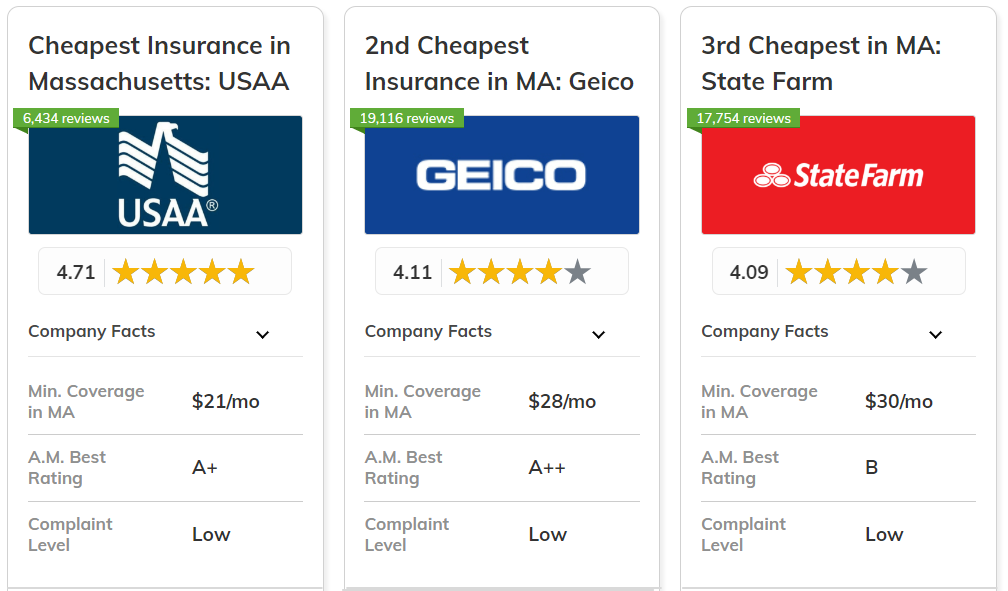
Massachusetts car insurance can swing fast from “pretty manageable” to “why is this so high?” depending on who is driving and what is being insured. The clearest way to understand your likely cost is to look at real-world driver profiles, not just state averages.
A teen on a financed sedan, a retired driver with a paid-off car, and a married couple bundling two vehicles can all live in the same ZIP code and still see dramatically different prices. That gap usually comes from a mix of driving history, vehicle value, household structure, commute patterns, and whether the policy needs only basic protection or broader coverage.
Who tends to pay more, and why
The sample ranges below are broad but realistic for Massachusetts. They show how risk level, household setup, and vehicle requirements can move premiums up or down even before discounts are applied.
| Driver type | Likely coverage choice | Estimated premium range | Major cost drivers |
|---|---|---|---|
| Teen driver on family policy | Full coverage | $3,500-$7,000/yr | Little experience, higher claim risk, newer vehicle |
| College student | Minimum to mid-level coverage | $1,800-$4,200/yr | Age, campus parking, limited history, occasional commuting |
| New Massachusetts resident | Mid-level or full coverage | $1,400-$3,000/yr | New rating territory, insurer switch, registration changes |
| Senior driver | Minimum or mid-level coverage | $1,000-$2,200/yr | Annual mileage, claims history, vehicle age |
| Married driver | Full coverage | $1,200-$2,600/yr | Bundling potential, steadier driving record, shared vehicles |
| Driver with speeding ticket or at-fault crash | State minimum to full coverage | $2,000-$5,500+/yr | Surcharge points, insurer risk tier, claim history |
These examples also shift based on how many vehicles are in the household and whether the car is financed. In practice, the structure of the policy often matters almost as much as the driver profile itself.
- One-car household: Often pays more per vehicle because there is no multi-car discount to soften the rate.
- Multi-car household: May lower the average cost per car, especially when both drivers have clean records.
- Financed vehicle: Usually requires collision and comprehensive, which can add hundreds or even thousands per year.
- Owned outright vehicle: Gives more flexibility to carry lower physical-damage coverage, especially on older cars.
- Teen plus financed SUV: One of the pricier combinations because both the driver and the vehicle create added insurer exposure.
- Retiree with paid-off compact car: Often lands near the lower end when mileage is low and the record is clean.
Consider how these scenarios play out in real life. A 19-year-old student in Boston with a financed crossover may pay far more than a 67-year-old in Worcester driving a paid-off sedan because the younger driver represents more statistical risk and the lender requires broader protection. Meanwhile, a married couple insuring two modest cars may pay less per vehicle than a single driver with one financed car, because shared policies can unlock discounts and spread risk differently.
Pro Tip: If your rate looks high, check whether the price is being driven more by the driver, the car, or the financing requirement. That tells you where changing vehicles, adjusting deductibles, or combining policies may have the biggest impact.
Ways to lower auto insurance costs in Massachusetts
Massachusetts drivers can often trim insurance bills without playing defense with their wallet. The smartest moves lower your premium and keep you protected when the road throws a surprise.
The key is to treat every discount as a trade: lower monthly cost now versus more risk, more effort, or less flexibility later. Use the options below to build savings deliberately instead of chasing the cheapest number on the page.
Smart discount moves that protect your budget
Start with the levers that insurers reward most often, then pressure-test each one. A low premium feels great until a high deductible, weak coverage, or missed discount makes a claim more painful. In practice, the best strategy is usually a mix of clean driving habits, quote comparisons, policy bundling, and carefully chosen deductibles.
Before changing a policy, weigh the upside and the caution points for each tactic:
- Bundle auto with home or renters insurance — Benefit: often unlocks one of the biggest discounts and simplifies billing. Caution: a bundle is not always the lowest total price, so compare the combined cost against separate policies.
- Raise your deductible — Benefit: lowers your premium quickly. Caution: you pay more out of pocket after a crash, so choose a deductible you could realistically cover from savings.
- Keep a clean driving record — Benefit: fewer violations and claims can protect discounts over time. Caution: safe driving saves gradually, not instantly, and one incident can erase part of the advantage.
- Take an approved driving course — Benefit: some drivers, especially younger or mature drivers, may qualify for discounts. Caution: not every course or driver profile earns savings, so confirm eligibility first.
- Improve vehicle safety — Benefit: anti-theft devices, garage parking, and advanced safety features may reduce risk in the insurer’s eyes. Caution: upgrades can cost more upfront than the discount is worth.
- Compare quotes regularly — Benefit: pricing can vary sharply between insurers for the same driver. Caution: the cheapest quote may cut useful coverage, add restrictions, or rely on discounts that disappear later.
| Savings method | How it works | Possible downside | Best use case |
|---|---|---|---|
| Bundling policies | Combines auto with home, condo, or renters coverage for a multi-policy discount | May limit flexibility if one policy is overpriced | Drivers who already need multiple insurance products |
| Higher deductible | Reduces premium by shifting more claim cost to you | Higher out-of-pocket expense after an accident | Drivers with a solid emergency fund |
| Defensive driving course | Completing an approved course may qualify for a discount | Time commitment and possible course fee | Newer drivers or households checking every discount |
| Shopping quotes | Compares prices and discounts across insurers | Lowest price may not offer the best protection | Anyone at renewal or after a life or vehicle change |
Pro tip: Lower premiums are only a win if your coverage still protects your savings, car, and future income. In Massachusetts, the better question is not just “How cheap can I get it?” but “How cheaply can I stay properly covered?”
How to compare quotes and choose the right policy
The cheapest quote can be the most expensive mistake if the coverage is thin or the claims experience is rough. Smart comparison is less about chasing the lowest number and more about making sure every quote is truly built on the same foundation.
In Massachusetts, the fastest way to compare fairly is to control the details yourself. Ask each insurer for the same driver information, the same vehicle details, and the same coverage structure, then review what changes the final price: limits, deductibles, optional add-ons, exclusions, and service quality.
Build a true apples-to-apples comparison
Before requesting quotes, prepare your details so each insurer evaluates the same risk profile. This reduces misleading price gaps caused by missing information or mismatched options.
- Full names, dates of birth, license numbers, and years licensed for all drivers in the household.
- Vehicle year, make, model, VIN, ownership status, annual mileage, and primary garaging ZIP code in Massachusetts.
- Current policy declarations page, including liability limits, deductibles, endorsements, and renewal date.
- Driving history, recent claims, completed safety courses, anti-theft devices, and bundling opportunities.
Once you have that ready, follow a simple process. First, request at least three quotes from reputable insurers or independent agents. Second, make sure each quote uses matching bodily injury, property damage, collision, and comprehensive limits. Third, compare deductibles carefully; a lower premium may simply hide a much higher out-of-pocket cost after an accident. Fourth, read exclusions and endorsements so you know whether rental reimbursement, glass coverage, roadside assistance, or accident forgiveness is included, optional, or absent. Fifth, verify the insurer’s reputation by reviewing complaint trends, financial strength, and claims responsiveness.
Pro Tip: Ask every insurer to email a quote breakdown, not just a total premium. Line-by-line pricing makes weak coverage or padded add-ons much easier to spot.
| Comparison point | What to review | Warning signs | Decision tip |
|---|---|---|---|
| Coverage match | Liability limits, PIP, uninsured coverage, collision, comprehensive, extras | One quote looks far cheaper because key protections are reduced or removed | Compare only quotes with the same structure first, then adjust intentionally |
| Deductibles | Collision and comprehensive deductibles, plus glass rules if relevant | Premium savings are small but deductible jumps sharply | Choose a deductible you could comfortably pay tomorrow, not just eventually |
| Exclusions and limits | Excluded drivers, business-use restrictions, custom equipment limits, rental caps | Important use cases are not covered or require separate endorsements | Match the policy to how you actually drive and use the car |
| Insurer quality | Claims service, complaint history, billing tools, local agent support | Frequent complaints about delays, low settlement offers, or poor communication | Paying a little more can be worth it for smoother claims and better support |
Value goes beyond price. A slightly higher premium may buy faster claims handling, stronger customer support, better digital tools, and more flexible policy changes if you move, add a driver, or switch vehicles. Also check discounts closely: safe-driver, low-mileage, multi-policy, autopay, paid-in-full, student, and telematics savings can change which insurer offers the best real-world deal.
When two quotes are close, use service quality as the tiebreaker. A policy that is easier to manage, easier to understand, and easier to rely on after a crash often delivers more long-term value than a bargain quote that becomes frustrating when you actually need help.
Pro Tip: If an agent cannot clearly explain deductibles, exclusions, or optional endorsements, treat that as a preview of the support you may receive later.
Summary
The cost of auto insurance in Massachusetts can feel unpredictable, but the pattern is clear once you know what moves the price. Your profile, coverage choices, and insurer all shape the final number. Compare equal quotes, protect yourself beyond the bare minimum when possible, and aim for balance instead of just the lowest premium. That is how smart drivers turn insurance from a routine expense into a confident financial decision.
FAQ
How much is car insurance per month in Massachusetts?
Many drivers pay roughly $50 to $200 per month, while higher-risk drivers may pay more.
Is Massachusetts auto insurance expensive?
It can be moderate to high depending on coverage, city, and driver history, especially for full coverage.
What is the cheapest type of auto insurance in Massachusetts?
Minimum required coverage is usually the cheapest, but it offers the least financial protection.
Why do Boston area drivers often pay more?
Urban areas usually have denser traffic, more claims, higher repair costs, and greater theft risk.
Does a clean driving record really lower premiums?
Yes. Drivers with no accidents or tickets often qualify for much better rates than those with violations or claims.
Do financed cars cost more to insure?
Often yes, because lenders commonly require collision and comprehensive coverage in addition to liability.
How can I lower my Massachusetts auto insurance cost?
Compare quotes, bundle policies, raise deductibles carefully, keep a clean record, and ask about discounts.