john hancock gold travel insurance is built for travelers who want more than bare-minimum single-trip protection. It fits families, cruise guests, international vacationers, and travelers with larger prepaid costs who need stronger support for trip cancellation, interruption, baggage problems, and emergency medical events.
Think of it as a practical safety net with wider value than basic coverage. While exact limits depend on the policy, Gold-level plans typically help with delays, missed connections, baggage setbacks, emergency evacuation, and selected medical needs abroad. The smartest move is simple: read benefit caps, exclusions, and pre-existing condition waiver deadlines early so your coverage works when travel gets unpredictable.






John Hancock Gold Travel Insurance Overview
John Hancock Gold Travel Insurance is built for travelers who want more than bare-minimum trip protection without jumping straight to a premium, all-out policy. It fits especially well for people booking meaningful vacations, family travel, cruises, or international trips where one disruption could turn expensive fast.
At its core, this plan is designed to help protect the money you put into a trip and support you when travel goes off-script. Compared with basic single-trip coverage, John Hancock Gold generally aims higher: it is not just about reimbursing one canceled booking, but about creating a more rounded safety net around your journey. That often means broader trip-related protection, stronger help for mid-trip disruptions, and practical travel assistance that matters when delays, lost baggage, or medical surprises happen away from home.
Why Gold Feels Like a Smarter Safety Net
For travelers who want balanced protection, the appeal of a Gold-tier plan is usually its blend of financial reimbursement and real-world support. Common protections typically include trip cancellation if a covered event forces you to cancel before departure, trip interruption if you need to cut travel short after it begins, baggage coverage for lost, stolen, or delayed belongings, and emergency medical support for unexpected illness or injury while traveling. In many cases, that mix makes it better suited than basic single-trip plans for travelers with larger prepaid costs, more connections, or destinations where out-of-pocket medical expenses could be stressful.
John Hancock Gold may be especially useful in travel situations like these:
- A prepaid international vacation with flights, hotels, and tours that would be costly to cancel.
- A cruise itinerary where missed connections or weather disruptions could derail multiple bookings.
- A family trip where one illness or emergency can affect every traveler on the reservation.
- A long-distance journey with checked baggage, tight schedules, and higher interruption risk.
Pro tip: Gold-level travel insurance often shines most when your trip includes several prepaid parts, not just a flight. The more moving pieces your itinerary has, the more valuable coordinated protection can become.
The table below gives a quick, practical snapshot of the plan’s core protection areas and how travelers usually benefit from them.
| Coverage Category | What It Protects | Typical Use Case | Important Limitation |
|---|---|---|---|
| Trip Cancellation | Prepaid, nonrefundable trip costs when a covered reason stops departure | You cancel due to illness, injury, or another eligible event before the trip | Not every reason is covered; cancellations must match policy terms |
| Trip Interruption | Unused trip expenses and possible added transport costs after departure | You must return home early because of an emergency | Benefits depend on the covered cause and documented loss |
| Baggage Protection | Loss, theft, damage, or delay involving personal belongings | Your suitcase is delayed and you need essential items | High-value items may have caps or special conditions |
| Emergency Medical Support | Help with covered medical emergencies and travel assistance while away | You get sick abroad and need treatment or coordination help | Routine care and non-covered conditions are typically excluded |
Coverage Benefits and What Is Included
John Hancock Gold is built to soften the financial shock of travel problems, not just describe them. The plan’s value shows up when a nonrefundable booking, a long airport delay, or a medical emergency suddenly turns into a real bill.
In plain language, this plan can help repay covered prepaid trip costs, extra travel expenses caused by interruptions, and certain emergency services when your trip goes off track. The key is understanding which event triggers which benefit, because each protection has its own rules, waiting periods, and maximum payout.
How Protection Shows Up at Each Stage of the Trip
Trip cancellation can help before departure if a covered reason forces you to cancel, such as serious illness, certain family emergencies, or severe weather. Trip delay can help during travel when a covered delay leaves you paying for meals, a hotel, or local transportation. Missed connection may step in if a delay causes you to miss a cruise departure or onward flight. Baggage delay helps when checked luggage arrives late and you need essentials. Medical evacuation is the high-impact benefit many travelers overlook: if you become seriously sick or injured, it may cover transportation to an appropriate medical facility or even back home when medically necessary.
Think of these benefits as practical backup for different moments of disruption:
- Before departure: Trip cancellation may reimburse prepaid, nonrefundable trip payments if a covered event stops the trip before it starts.
- During travel: Trip delay may reimburse reasonable extra costs like lodging and meals after a covered delay passes the plan’s minimum time requirement.
- During travel: Missed connection may help with catching up to a tour, cruise, or connecting itinerary when a covered delay causes the miss.
- During travel: Baggage delay may reimburse clothing, toiletries, and basic necessities when your bags do not arrive on time.
- During travel: Medical evacuation may cover ambulance or air transport arranged for an emergency to reach proper treatment.
- After disruption: Claims usually depend on receipts, carrier statements, and medical proof showing the event was covered and the expense was necessary.
Here is a practical way to read those protections in real-world terms:
| Benefit | Travel Scenario | Potential Reimbursement Type | Claim Document Needed |
|---|---|---|---|
| Trip Cancellation | You get pneumonia two days before departure and cannot travel | Unused prepaid, nonrefundable trip costs | Doctor letter and supplier cancellation invoices |
| Trip Delay | Storms delay your flight overnight | Hotel, meals, and local transport | Airline delay statement and itemized receipts |
| Missed Connection | Your late inbound flight causes you to miss cruise embarkation | Catch-up transportation and extra lodging | Carrier proof of delay and new booking receipts |
| Baggage Delay | Your checked bag arrives the next day in Rome | Essential personal items | Baggage delay report and purchase receipts |
| Medical Evacuation | You suffer a serious injury in a remote destination | Emergency transport to suitable care | Medical records and evacuation authorization |
Use this quick lens to match the timing of the problem to the likely benefit:
- If the trip never begins, look first at trip cancellation.
- If the trip is still happening but delayed, review trip delay or missed connection.
- If your belongings are the issue, baggage delay is usually the relevant protection.
- If health and transport become urgent, medical evacuation can be the most financially significant benefit on the policy.
Pro tip: Benefit names sound broad, but payout limits are not unlimited. A plan may cover a type of problem, yet still cap reimbursement by per-person maximums, daily limits, or specific sub-limits. Reading those numbers closely helps you avoid assuming full repayment when the policy may only cover a defined portion of the loss.
Exclusions, Limitations, and Pre-Existing Condition Rules

Great travel insurance can feel like a safety net, but every net has holes. Before buying John Hancock Gold Travel Insurance, study the exclusions and timing rules carefully, because the difference between a paid claim and a denial often lives in the fine print.
Most travel insurance plans are built to cover sudden, unforeseen, and documented losses, not every disruption that happens during a trip. That means travelers should pay close attention to excluded events, activity-related restrictions, medical history rules, and the paperwork standards required to prove a covered loss.
Fine-Print Triggers That Catch Travelers Off Guard
One of the biggest issues to review is how the plan treats foreseeable events. If a storm is already named before you buy, a destination is already unstable, or a medical issue is already worsening, the insurer may decide the loss was not unexpected. Plans also commonly limit or exclude claims linked to high-risk activities, intoxication, illegal acts, routine care, or travel booked only after a problem was already known. Another practical limitation is documentation: even a valid loss can become difficult to reimburse if receipts, medical records, cancellation notices, or airline statements are missing.
Pre-existing medical condition rules can be especially important for older travelers, families, and anyone managing ongoing treatment. In many travel insurance policies, a pre-existing condition may refer to an illness, injury, or symptom that existed, was treated, or changed during a defined lookback period before the policy purchase date. Some plans may offer a pre-existing condition waiver, but this often depends on time-sensitive requirements such as buying coverage shortly after making the initial trip deposit, insuring the full nonrefundable trip cost, and being medically able to travel when the policy is purchased. Because waiver rules can be strict, travelers should verify the exact deadline and eligibility terms in the certificate wording before relying on that protection.
Use this quick-reference table to spot trouble areas before checkout.
| Exclusion Type | Description | Example Situation | Precaution |
|---|---|---|---|
| Foreseeable event | Loss tied to a known issue before purchase | Buying after a hurricane is named, then canceling | Purchase early, before major risks are known |
| Pre-existing condition | Medical issue within the plan’s lookback window | Canceling due to a heart condition recently treated | Check waiver deadline and eligibility rules |
| Risky activity | Adventure sports may be excluded or limited | Injury during mountaineering or off-trail racing | Confirm the activity is specifically covered |
| Incomplete proof | Claim lacks required records or receipts | No doctor note for trip interruption claim | Keep every invoice, report, and cancellation email |
Denials are often caused less by bad luck and more by preventable mistakes. Watch for these common errors:
- Waiting too long to buy the policy and missing the waiver window.
- Insuring only part of the prepaid trip cost when full cost is required.
- Assuming every sport or excursion is covered without checking definitions.
- Filing a claim without medical notes, receipts, or supplier cancellation proof.
- Ignoring policy wording around known events, advisories, or expected disruptions.
- Traveling against medical advice or after a condition has already worsened.
Pro Tip: Buy the policy soon after your first trip payment, save every booking and medical document in one folder, and read the waiver language line by line. That small effort can dramatically reduce claim friction later.
Pricing Factors, Plan Value, and Comparison Points
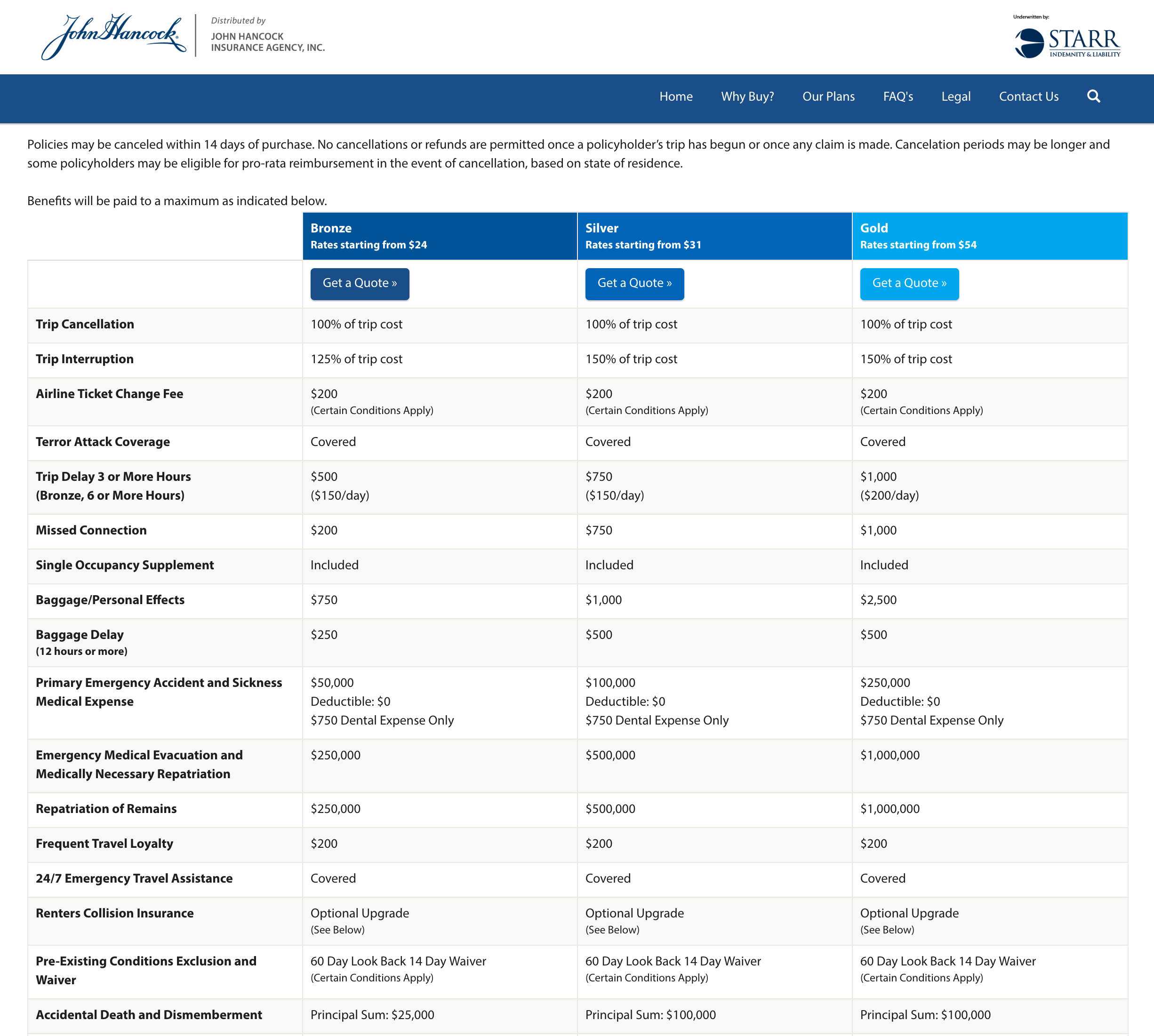
Price is never just a number with travel insurance; it reflects how much risk you are asking the plan to absorb. With John Hancock Gold, cost and value tend to move together, making it a strong middle-ground choice for travelers who want more than bare-minimum protection without jumping straight to premium-tier pricing.
The biggest pricing drivers are straightforward: traveler age, total trip cost, destination, and trip length. Older travelers often pay more because medical risk rises with age. More expensive trips usually mean higher premiums because cancellation and interruption exposure increases. International or remote destinations can raise the price when medical care, evacuation, or logistics are more complex. Longer trips also tend to cost more because the plan covers a wider travel window and more opportunities for disruption.
How Gold Balances Budget and Breathing Room
John Hancock Gold typically sits in the sweet spot between basic and premium travel protection. Compared with lower-tier plans, it usually delivers better reimbursement ceilings, broader trip disruption support, and more meaningful protection for travelers who would feel the financial sting of delays, cancellations, or medical surprises. Compared with higher-tier coverage, Gold often looks attractive when you want solid flexibility and stronger benefits without paying top-dollar for every possible add-on or elevated limit.
Paying more for broader protection can be especially worthwhile when the trip itself carries higher stakes. Families may benefit from stronger cancellation and interruption coverage because one illness or schedule change can affect multiple travelers at once. Seniors often value more robust medical and evacuation protection, especially for longer or overseas itineraries. International travelers may find the extra cost easier to justify when navigating unfamiliar healthcare systems, language barriers, and higher out-of-pocket risks abroad.
Here is a quick way to judge whether Gold offers strong value for your trip:
- Strongest value feature: often delivers a better balance of price and protection than entry-level plans.
- Strongest value feature: more useful for mid-priced to expensive trips where cancellation losses matter.
- Strongest value feature: added reassurance for overseas travel where medical coordination can be harder.
- Possible tradeoff: costs more than basic coverage, so it may feel excessive for very cheap or short domestic trips.
- Possible tradeoff: premium-tier plans may still offer higher limits or broader optional flexibility for complex travel.
Pro Tip: If losing the trip investment would hurt more than the premium, Gold often becomes easier to justify. The more moving parts your itinerary has, the more valuable broader disruption protection becomes.
| Factor | Effect on Price | Effect on Coverage Value | Traveler Type Most Impacted |
|---|---|---|---|
| Age | Usually increases premium for older travelers | Higher value when medical-related protections matter more | Seniors, retirees |
| Trip Cost | Higher insured trip cost usually means higher premium | Improves value when cancellation losses would be significant | Families, luxury travelers |
| Destination | International or remote destinations may raise cost | Boosts value where medical care or evacuation is expensive | International travelers, cruisers |
| Trip Length | Longer trips generally cost more to insure | Increases value because disruption risk grows over time | Long-stay travelers, multi-stop travelers |
In practical terms, lower-tier protection may be enough for budget-conscious travelers taking short, low-cost trips with minimal complexity. Gold becomes more compelling when you want deeper financial protection and a more comfortable margin for unexpected changes, while top-tier plans make the most sense when you need the broadest possible limits, richer optional benefits, or maximum peace of mind for high-value international travel.
Claims Process, Required Documents, and Customer Experience
A smooth claim is rarely about luck; it is about proof. With John Hancock Gold travel insurance, travelers who document fast, organize clearly, and submit completely usually create a far better reimbursement experience.
The typical process starts when a covered event happens and the traveler notifies the insurer, gathers evidence, completes claim forms, and uploads supporting records for review. After submission, the claim team may request clarification, verify dates and payments, and compare the loss with policy terms before approving reimbursement, asking for more documents, or partially denying items that lack support.
Proof-First Filing Strategy
Each claim category depends on timing, documentation, and readable proof of loss. For trip cancellation, insurers often want the booking invoice, cancellation confirmation, reason documentation, and proof that prepaid costs were nonrefundable. For baggage loss, expect airline reports, baggage claim tags, itemized lists, and settlement details from the carrier. For medical treatment, keep physician notes, diagnosis records, bills, prescriptions, and payment receipts. For delays, save airline notices, revised itineraries, hotel and meal receipts, and timestamps showing how long the interruption lasted.
Good organization can prevent avoidable slowdowns. Keep digital copies of receipts, medical paperwork, airline emails, and card statements in one folder labeled by date and event. If a document is hard to read, photograph it again immediately. Match every expense to a payment record so the reviewer can quickly confirm what was actually paid and why it relates to the covered incident.
Use this simple preparation workflow to build a stronger, faster-moving claim file:
- Report the incident promptly to the airline, hotel, tour provider, police, or medical provider when relevant.
- Open the insurance claim as soon as possible and note the claim number for every follow-up.
- Download or request official notices, such as cancellation letters, delay confirmations, or baggage reports.
- Collect proof of booking and payment, including invoices, card statements, and confirmation emails.
- Save all receipts for out-of-pocket costs and write a short note explaining each expense.
- Upload complete, clearly named files instead of scattered screenshots with vague filenames.
- Review the submission for missing dates, signatures, unreadable images, and duplicated charges.
Pro Tip: Do not wait until you return home to organize evidence. Creating a same-day folder on your phone for receipts, notices, and photos can turn a messy claim into a persuasive one.
| Claim Type | Required Evidence | Common Delay Reason | Preparation Tip |
|---|---|---|---|
| Trip Cancellation | Booking invoice, cancellation notice, medical or event documentation, proof of payment | Missing proof that costs were nonrefundable | Save original terms and supplier cancellation emails |
| Baggage Loss | Airline property report, bag tags, item list, carrier settlement details | No official airline report number | File the baggage report before leaving the airport |
| Medical Treatment | Doctor notes, diagnosis, bills, prescriptions, payment receipts | Incomplete treatment records or untranslated documents | Request itemized bills and discharge paperwork immediately |
| Travel Delay | Carrier delay notice, updated itinerary, meal or hotel receipts, payment proof | No evidence of delay length | Keep screenshots showing departure changes and timestamps |
Best Use Cases, Travel Scenarios, and Visual Content Ideas
John Hancock Gold Travel Insurance tends to shine when a trip carries real moving parts, real costs, and real chances for disruption. It is often a practical middle ground for travelers who want more than bare-bones protection without stepping into an ultra-premium plan.
Its strongest fit is usually for travelers who would feel a cancellation, delay, or medical event in both time and budget. Think family vacations with prepaid bookings, cruise itineraries tied to strict departure schedules, and international trips where medical help, baggage recovery, or emergency transportation could become complicated fast.
Who Gets the Most Practical Edge
Families often benefit when multiple travelers, connecting flights, and prepaid reservations increase the odds that one illness or delay affects the entire trip. Cruise travelers are another strong match because missing embarkation, weather changes, or port interruptions can create expensive domino effects. International vacationers may see value when navigating foreign medical care, language barriers, transportation logistics, and urgent coordination far from home. Gold-level protection can feel especially useful when the trip is not just a getaway, but a carefully assembled investment of deposits, tickets, and timed reservations.
Here are sample situations that help illustrate how the plan may respond in everyday travel stress points.
- A child gets sick the night before departure, forcing a family to cancel a resort stay and flights.
- A storm grounds airport traffic, causing missed connections, overnight delay costs, and rescheduling pressure.
- A cruise passenger misses the ship after a weather-related flight interruption and needs help catching up at the next port.
- Luggage disappears on arrival abroad, leaving the traveler to replace essentials while the airline searches.
- A traveler develops a serious medical issue overseas and requires transport to an appropriate facility or evacuation support.
For visual storytelling, use scenes that make protection feel tangible rather than abstract. An airport-delay illustration can show a departure board full of red alerts, weary travelers charging phones, and a family reviewing backup plans at the gate. A cruise-interruption image works well with a ship at port, rolling weather, and a traveler coordinating revised boarding or onward transport. A medical-assistance-abroad visual should feature a clinic reception desk, translation help, and a traveler receiving calm, organized support. For travel-document organization, depict passports, confirmations, emergency numbers, and receipts neatly arranged in a folder or mobile app dashboard to reinforce preparedness.
These trip styles often make Gold-level protection easier to justify in practical terms.
- Multi-city international vacations with flights, hotels, and tours booked in advance.
- Family beach trips during hurricane or storm-sensitive seasons.
- Cruises with pre-cruise flights and hotel nights.
- Guided vacations with strict departure dates and nonrefundable deposits.
- Celebration trips such as anniversaries, graduations, or milestone birthdays.
Pro Tip: The more your itinerary depends on timing, prepaid costs, and coordination across airlines, hotels, or ports, the more valuable organized documentation becomes if you need to use the plan effectively.
| Traveler Profile | Trip Example | Relevant Protection | Planning Note |
|---|---|---|---|
| Family travelers | Theme-park vacation with flights and resort booking | Trip cancellation, delay support, baggage help | Useful when one person’s illness can disrupt everyone’s plans |
| Cruise passengers | Caribbean cruise with connecting flight to embarkation city | Trip interruption, missed connection-related assistance, baggage protection | Build in early arrival time before sailing day |
| International vacationers | Two-week Europe itinerary across several countries | Medical assistance abroad, evacuation support, baggage loss response | Keep digital and printed copies of key travel records |
| Milestone-trip planners | Anniversary or celebratory guided tour | Protection for prepaid trip investment and disruption costs | Best when deposits are high and dates are hard to replace |
Last Word
Great travel memories deserve better backup than guesswork. If your trip involves expensive bookings, multiple stops, cruise timing, or overseas uncertainty, john hancock gold travel insurance can offer meaningful peace of mind when plans suddenly shift. Compare limits carefully, save every document, and choose protection that matches the real shape of your journey, not just the price on the checkout page.
Frequently Asked Questions
What is john hancock gold travel insurance best for?
It is often best for travelers who want broader protection than basic single-trip plans, especially for costly vacations, cruises, and international travel.
Does it usually cover trip cancellation and interruption?
Yes, Gold-level travel plans commonly include trip cancellation and trip interruption for covered reasons, subject to policy terms and maximum limits.
Can it help with travel delays and missed connections?
Often yes. If a covered delay causes extra meals, lodging, or a missed onward segment, reimbursement may apply when you keep receipts and carrier notices.
Is emergency medical evacuation included?
Many Gold-tier plans include emergency medical evacuation support, which can be crucial if you need transport to an appropriate medical facility during a covered emergency.
How do pre-existing condition rules usually work?
Coverage may depend on a time-sensitive waiver requirement, often linked to buying the policy soon after the initial trip deposit and insuring the full trip cost.
What documents are commonly needed for a claim?
Travelers usually need receipts, booking invoices, proof of payment, airline or cruise notices, baggage reports, medical records, and any cancellation statements.
What can cause a claim to be denied?
Common reasons include excluded events, foreseeable disruptions, risky activities, late policy purchase for waiver eligibility, or incomplete claim documentation.