Choosing the top three insurance companies sounds simple, but the smartest answer depends on what “top” really means for you. A giant brand may lead in market share or revenue, while another wins on claim speed, customer satisfaction, policy flexibility, or financial strength. Rankings also shift by country, product line, and evaluator, so life, health, auto, home, and commercial insurers should never be judged by one scoreboard alone.
Think of insurance selection as strategy, not popularity. Compare policy wording, deductibles, exclusions, renewal terms, digital tools, discounts, riders, support quality, complaint patterns, and claim settlement habits. Strong financial reserves show stability, but daily customer experience reveals whether that strength reaches real policyholders. The best insurer for a family, senior, business owner, high-risk driver, or frequent traveler can be very different, which is why a focused comparison beats a famous logo every time.





Understanding What “Top Three Insurance Company” Can Mean
“Top three” sounds simple, but in insurance, it can point to very different winners. A company can dominate headlines, yet another may outperform it where policyholders actually feel the difference: service, stability, and claims.
Insurance rankings shift because people measure success in different ways. Some lists reward market share or total revenue, which usually highlights giant insurers with broad reach. Others focus on policy count, customer satisfaction, financial strength ratings, or claims performance, which can elevate companies that are less famous but more dependable in specific situations. That is why the “best” top three in one report may not match another report at all.
Why One Leaderboard Can Tell Several Stories
The phrase “top insurance company” changes meaning depending on country, product line, and source methodology. In one market, a life insurer may lead by assets; in another, a health insurer may rank first by enrollment. Auto and home insurers are often judged more heavily on claims speed and service responsiveness, while commercial insurers may be compared through underwriting expertise, risk capacity, and industry specialization. Even the source matters: consumer surveys often spotlight user experience, while rating agencies emphasize capital strength and long-term ability to pay claims.
Major insurance categories also reshape the comparison. Life insurance is often evaluated through solvency, dividends, and long-term guarantees. Health insurance may be judged by network access, claims approval, and affordability. Auto and home insurance usually bring pricing, coverage flexibility, and claims handling into sharper focus. Commercial coverage adds another layer, because business risks vary widely across industries and policy structures.
| Ranking Factor | Meaning | Common Metric | Why It Matters |
|---|---|---|---|
| Market share | How much of the market a company controls | Premium share by segment or country | Shows scale, brand reach, and competitive presence |
| Revenue or premiums | Total business volume generated | Annual revenue or written premiums | Signals size, but not always quality or service |
| Policy count | Number of active customers or contracts | Policies in force | Suggests broad adoption and operational capacity |
| Customer satisfaction | How customers rate their experience | Survey scores, retention, complaint ratios | Helps reveal service quality beyond advertising |
| Financial strength | Ability to meet future obligations | AM Best, S&P, Moody’s, Fitch ratings | Critical for confidence in long-term claim payment |
| Claims performance | How fairly and quickly claims are handled | Payout speed, settlement ratio, dispute rate | Shows whether support is strong when losses happen |
Before trusting a “top three” label, it helps to separate visibility from real value. Many buyers make fast assumptions based on recognition alone, and that can hide important weaknesses.
- Assuming the biggest brand automatically offers the best policy terms.
- Judging quality from advertising volume instead of claims results.
- Comparing a life insurer and an auto insurer as if they serve the same need.
- Ignoring country-specific regulation, pricing, and market structure.
- Overlooking financial ratings because the company feels familiar.
- Focusing on cheap premiums without checking exclusions, deductibles, or payout reliability.
Pro tip: A smart reader does not ask, “Who is number one?” first. A smarter question is, “Number one by which standard, in which insurance category, and for what kind of buyer?”
That framing instantly makes the comparison sharper, more realistic, and far more useful for anyone trying to identify a truly strong insurer instead of simply a famous one.
Most Recognized Insurance Companies Commonly Appearing in Top Rankings
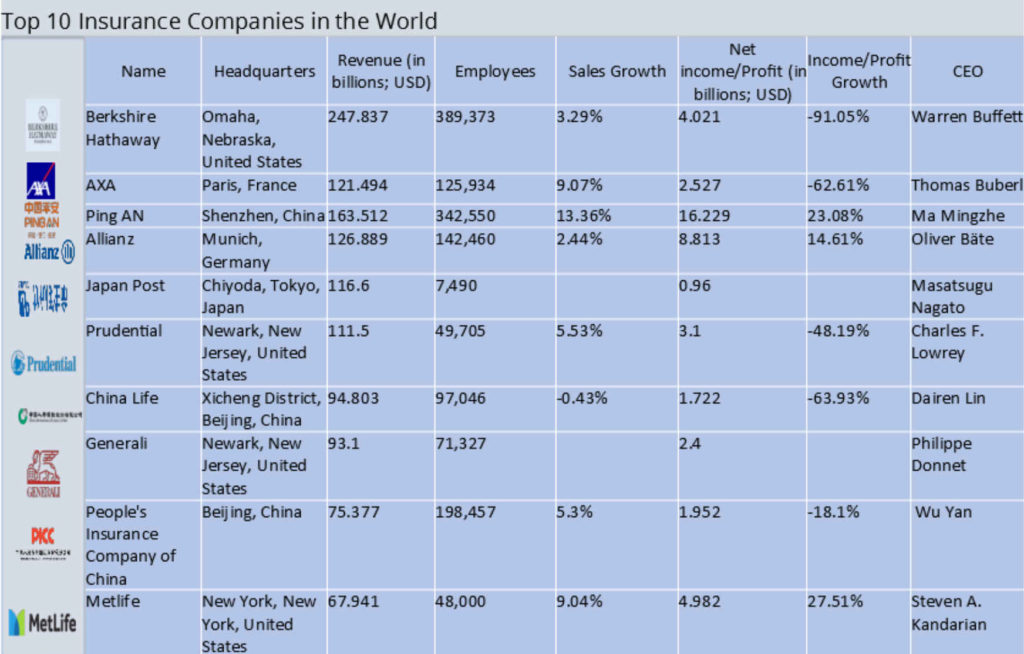
When people ask who belongs in the “top three,” the same names surface again and again—but not always for the same reason. Some dominate by global scale, others by brand trust, specialist coverage, or sheer regional influence.
In global conversations, insurers such as Allianz, AXA, and Ping An are frequently mentioned because they combine broad reach with strong visibility across multiple insurance segments. In regional markets, names like UnitedHealth Group, Zurich, and Nippon Life also enter top-three debates depending on whether buyers care most about health, life, property, or commercial protection.
Big Names, Different Strengths
The strongest-known insurers are not interchangeable. Allianz is widely associated with diversified protection and global corporate capability, AXA with broad retail and business insurance reach, and Ping An with massive scale and integrated financial services in China. Meanwhile, companies such as UnitedHealth Group stand out in health coverage, while Zurich is often recognized for commercial insurance and international risk solutions.
| Company Name | Primary Insurance Segment | Notable Strength | Typical Customer Profile |
|---|---|---|---|
| Allianz | Life, P&C, commercial | Global diversification and strong enterprise presence | Families, affluent clients, multinational businesses |
| AXA | Life, health, property, business | Wide international footprint and balanced product range | Everyday consumers and SMEs wanting one broad provider |
| Ping An | Life, health, integrated financial services | Huge market scale and digital ecosystem strength | Customers in Asia seeking tech-enabled convenience |
| UnitedHealth Group | Health insurance | Deep healthcare network integration | Individuals, employers, and seniors focused on medical coverage |
| Zurich | Commercial, property, casualty | Risk management expertise for complex exposures | Businesses, professionals, and internationally active firms |
These companies often appear in rankings for different reasons, so it helps to read the label behind the praise. Before deciding which “top” name deserves attention, consider what kind of buyer you are:
- Life-planning buyers often lean toward firms known for long-term stability and retirement products.
- Health-focused buyers usually prioritize provider networks, claims access, and care coordination over brand size alone.
- Business owners tend to value underwriting depth, risk advisory services, and cross-border capability.
- Digital-first customers may prefer insurers with smoother apps, faster policy management, and simpler claims workflows.
Market snapshot: Allianz is often best known as a globally balanced insurance powerhouse with strong appeal across personal and commercial lines.
Market snapshot: AXA is widely recognized for accessibility, breadth, and a dependable mix of retail and corporate insurance solutions.
Market snapshot: Ping An is best known for combining insurance scale with a powerful digital ecosystem, especially in Asia.
Market snapshot: UnitedHealth Group is most visible where health coverage quality, network reach, and managed care matter most.
Size can impress, but fit wins. A giant insurer may offer excellent capital strength and extensive product menus, yet still feel too complex, too expensive, or too generic for a buyer with simple needs. A regional leader or segment specialist can sometimes deliver faster service, more tailored underwriting, or stronger value in the exact category a customer actually needs.
How to Compare the Top Three Insurance Companies by Product and Service
Three insurers can look equally impressive on paper, yet feel completely different when you compare what they actually sell, how they serve, and how they pay. The smartest choice comes from reading beyond brand reputation and testing the real buyer experience.
Start by comparing the full policy package, not just the quoted price. Look at coverage types, optional add-ons, premium payment flexibility, rider availability, loyalty or bundling discounts, mobile tools, and how easy it is to reach a real support agent. A lower premium can lose its appeal fast if the policy has narrow terms, weak digital access, or slow help during stressful moments.
The Side-by-Side Buying Filter That Reveals the Real Winner
When reviewing top insurers, focus on how each company performs across the moments that matter most: buying, updating, claiming, and renewing. Compare whether plans are customizable, whether premiums can be paid monthly, quarterly, or annually, and whether useful riders are available without inflated cost. Check for digital strengths such as quote tracking, online document access, claim uploads, chat support, and renewal reminders. Also examine claims handling by asking how quickly claims are acknowledged, what documents are required, whether status updates are easy to follow, and how disputes are escalated. A provider with clear policy wording, predictable claims timelines, and visible complaint-resolution channels often delivers more value than one with a flashy headline rate.
Use this step-by-step review method before choosing between three providers:
- Match the same coverage type across all three quotes so the comparison stays fair.
- Read the benefit schedule and identify what is covered, capped, or subject to waiting periods.
- Highlight exclusions, especially pre-existing conditions, high-risk use, property limits, and non-covered events.
- Check deductibles or excess amounts and calculate what you would pay out of pocket in a real claim.
- Review renewal rules, including repricing terms, cancellation rights, and whether benefits change after renewal.
- Test service quality by contacting support with one practical question and timing the response.
Pro tip: If two insurers offer similar prices, the better choice is often the one with simpler wording, fewer surprise exclusions, and a more transparent claims path.
Before making the final pick, run through these essential checkpoints:
- Are policy limits and sub-limits high enough for your real risk?
- Does the insurer offer riders you may actually need, not just optional extras that sound attractive?
- Can you adjust payment frequency without heavy admin fees?
- Are discounts tied to conditions that may disappear after the first term?
- Is the claims process digital, trackable, and supported by human assistance?
- Does the company explain complaints, appeals, and dispute resolution clearly?
| Comparison Area | What to Review | Warning Signs | Ideal Outcome |
|---|---|---|---|
| Policy Design | Core coverage, limits, riders, exclusions, waiting periods | Vague wording, too many carve-outs, low sub-limits | Clear benefits with flexible add-ons and balanced exclusions |
| Price Structure | Premium options, deductibles, discounts, renewal pricing | Cheap first year, sharp renewal jump, hidden fees | Transparent pricing with stable renewal terms |
| Claims Experience | Claim intake speed, document rules, status updates, payout process | Slow responses, unclear timelines, hard-to-track claims | Fast acknowledgment, visible progress, documented standards |
| Service Access | App features, web portal, phone/chat support, complaint channels | Broken digital flow, long hold times, unclear escalation path | Easy self-service plus responsive human support |
Financial Strength, Trust, and Customer Experience Indicators

The “best” insurer is not just the one with a famous name; it is the one that can still pay claims quickly and fairly when life turns expensive. Smart buyers look past marketing and examine both balance-sheet strength and real customer behavior.
Financial strength shows whether an insurer is built to withstand catastrophes, economic shocks, and years of future obligations. Customer experience indicators reveal what happens after you buy: whether support is responsive, complaints stay low, policyholders remain loyal, and claims are handled with consistency. Together, these signals create a sharper picture of trust than any single ranking can offer.
The Proof Behind the Promise
When reviewing insurers, start with the foundation: financial ratings, solvency levels, reserves, and long-term operating stability. These help indicate whether the company has enough capital, disciplined risk management, and the ability to honor claims over time. A company with strong reserves and healthy solvency is generally better positioned to keep promises during disasters, inflation spikes, or market downturns.
That said, numbers on paper should be paired with everyday service evidence. Customer reviews, complaint ratios, retention rates, and claim settlement records help show whether policyholders actually feel supported. Reviews can reveal patterns in billing, communication, or delays; complaint ratios can highlight whether issues occur more often than expected for the company’s size; retention rates may suggest satisfaction and trust; and settlement records can hint at how dependably claims are resolved.
Trusted third-party score categories can be useful reference points, especially in areas such as financial health, claims satisfaction, complaint performance, and service quality. Still, they should guide your research rather than replace it. A high score is helpful, but your final decision should also reflect product fit, pricing, local service access, and your own risk priorities.
To keep your evaluation practical, separate the insurer’s ability to pay from the experience of being its customer.
- Financial strength indicators focus on capital adequacy, reserve quality, solvency, profitability consistency, and long-term stability.
- Customer experience indicators focus on claim speed, complaint frequency, review patterns, renewal loyalty, and ease of communication.
- Financial strength answers: “Can this insurer pay?”
- Customer experience answers: “Will dealing with this insurer feel reliable and fair?”
Pro Tip: If an insurer looks excellent financially but repeatedly shows weak complaint or claims-service signals, treat that as a yellow flag—not a deal-breaker, but a reason to dig deeper before buying.
| Indicator Type | What It Measures | Why It Matters | How to Interpret It |
|---|---|---|---|
| Financial Ratings | Independent view of financial capacity and risk strength | Helps assess whether the insurer can meet future obligations | Higher and more stable ratings usually suggest stronger claim-paying ability |
| Solvency and Reserves | Capital cushion and funds set aside for expected claims | Shows readiness for heavy claim periods or major loss events | Healthy margins and consistent reserves are generally positive signs |
| Complaint Ratio | Volume of complaints relative to company size | Reveals recurring service or claims-handling issues | Lower ratios tend to indicate smoother customer experience |
| Claims and Retention Record | Settlement consistency, customer loyalty, and renewal behavior | Shows whether people stay and whether claims outcomes feel dependable | Strong retention plus steady claim performance can signal lasting trust |
Choosing the Right Top Insurance Company for Different Buyer Needs
The “top” insurance company is not a universal winner; it is the one that fits your life with the least friction and the most confidence. A smart choice happens when your risks, budget, and service expectations line up with what an insurer actually does best.
That is why rankings alone are not enough. One insurer may shine for low-cost auto coverage, while another stands out for family-friendly bundling, strong travel support, or fast claims handling. The real advantage comes from matching your priorities to insurer strengths instead of chasing a famous name.
Buyer-Need Matching in Real-Life Situations
The best insurer changes with the buyer profile. A solo professional may care most about price and app speed, while a family may value bundled policies and dependable support. Seniors often look for clarity and service, business owners need flexible risk protection, high-risk drivers need access and manageable premiums, and frequent travelers benefit from insurers with broad emergency networks and efficient claims systems.
Use these buyer profiles to focus on the features that matter most before comparing brands.
- Individuals: prioritize affordable premiums, easy digital tools, quick quotes, and simple policy management.
- Families: look for bundle discounts, higher liability options, add-on flexibility, and responsive claims support.
- Seniors: value transparent terms, patient customer service, stable pricing, and strong medical or life coverage options.
- Business owners: focus on policy customization, commercial liability depth, risk-specific endorsements, and claims reliability.
- High-risk drivers: need insurers willing to underwrite complex histories, offer installment flexibility, and provide pathways to lower rates over time.
- Frequent travelers: prioritize global assistance, trip interruption protection, emergency medical benefits, and fast reimbursement.
Here is a practical way to compare which type of insurer may suit different priorities and budgets.
| Buyer Scenario | Coverage Priority | Best Insurer Type |
|---|---|---|
| Young renter with a tight monthly budget | Low premium and mobile convenience | Digitally efficient, price-competitive insurer |
| Family with home, two cars, and children | Bundling, liability limits, dependable service | Multi-policy insurer with strong support teams |
| Retiree seeking peace of mind | Clarity, stable service, easy claims help | Service-oriented insurer with strong reputation |
| Small business owner with changing risks | Customization and broader protection | Commercial specialist insurer |
| Driver with past violations | Availability and manageable payments | High-risk-friendly insurer |
| Consultant flying internationally every month | Emergency travel support and speed | Travel-focused insurer with global network |
To match policy goals with insurer strengths, follow a simple procedure. Start by listing your top three needs: affordability, customization, speed, or support quality. Next, decide what you can compromise on. Then compare insurers by quote range, coverage options, claim response reputation, and ease of getting real human help. Finally, test the buying experience itself; the quote process, policy language, and response time often reveal more than marketing slogans.
- Define your must-haves and your budget ceiling.
- Rank service factors: fast claims, live support, flexible add-ons, or digital convenience.
- Compare at least three insurers using the same coverage limits and deductibles.
- Review exclusions, payment terms, and upgrade options before deciding.
Sample recommendation logic: If you are budget-focused, lean toward insurers known for competitive pricing and discount stacking. If you are service-focused, favor carriers with strong claims communication and accessible support. If you are protection-focused, choose insurers offering broader limits, richer add-ons, and better customization even if the premium is higher.
Practical Content Enhancements for Better Reader Understanding
Readers do not just need names; they need tools that turn insurance jargon into confident action. This section makes the “top three” easier to judge with quick definitions, a smart checklist, and a visual comparison concept.
When people compare insurers, confusion usually comes from unfamiliar terms and scattered criteria. By combining a mini glossary, a quote-prep checklist, a simple decision framework, and a comparison-friendly table, you help readers move from passive browsing to clear, informed shortlisting without drowning them in technical detail.
Reader Tools That Make Comparison Instantly Clear
Start with a compact glossary so readers can decode policy language fast. Then guide them through a practical review sequence before they request a quote. The goal is not to crown one insurer for everyone, but to help each reader spot the company that best matches their risks, budget, and service expectations with less guesswork and better questions.
| Term | Simple Meaning | Why It Matters | Example Use Case |
|---|---|---|---|
| Premium | The amount you pay for the policy | A lower price may still mean weaker benefits | Comparing monthly auto insurance costs |
| Deductible | The amount you pay before insurance helps | It affects both affordability and out-of-pocket risk | Paying the first $500 of a repair claim |
| Rider | An add-on that expands or changes coverage | Useful for customizing a standard policy | Adding critical illness protection to life insurance |
| Underwriting | The insurer’s process for evaluating risk | It influences approval, pricing, and exclusions | A health review before issuing life coverage |
| Claim | A request for payment after a covered loss | Claim speed and fairness shape real-world value | Filing after storm damage to a home |
| Coverage Limit | The maximum amount the insurer will pay | Low limits can leave costly gaps | A property policy capped at $250,000 |
Before requesting quotes, readers should use this checklist to avoid comparing polished marketing instead of actual protection.
- Check whether the policy covers your main risk, not just common scenarios.
- Compare premium, deductible, and coverage limit together, not one by one.
- Look for optional riders that may matter more than a slightly lower price.
- Review claim reporting steps and expected response times.
- Scan customer support availability, including phone, app, and live-agent access.
- Confirm exclusions so “covered” does not hide major blind spots.
To narrow the top three without oversimplifying policy details, use this decision framework in order.
- Define your priority: lowest cost, broader protection, faster claims, or stronger digital service.
- Remove any insurer whose coverage gaps conflict with your real-life needs.
- Rank the remaining options by value, not price alone.
- Use reviews and service indicators as tie-breakers, not as the only deciding factor.
Pro Tip: If two insurers look similar, ask for the same coverage structure from both. Matching deductibles, limits, and riders makes quote comparisons dramatically more honest.
For the visual layer, imagine an illustration with three side-by-side insurer panels: each marked by a shield icon, a policy document card, and a claim flow path using arrows from incident to payout. Add trust badges near financial stability markers and customer service symbols such as headset, chat bubble, or mobile app icon. On mobile screens, these panels can stack vertically while icons remain bold and scannable, preserving clarity without crowding the page.
Conclusion
The real winner in the search for who is the top three insurance company is not always the biggest name but the provider that matches your goals with precision. When you balance affordability, customization, trust, and service performance, the choice becomes sharper and more confident. Compare carefully, question boldly, and let your priorities lead because the right insurance partner protects more than money, it protects peace of mind.
Q&A
What can “top three insurance company” mean?
It can mean highest market share, strongest revenue, best claims performance, top customer satisfaction, or excellent financial ratings.
Why do top three rankings differ so much?
They vary by country, insurance type, and scoring method, so a leader in auto insurance may not lead in life or health coverage.
Which insurers are often seen in top discussions?
Globally recognized names and regionally dominant carriers often appear, especially those known for scale, capital strength, and broad product reach.
Does the biggest insurance company mean the best choice?
No. Size can signal stability, but the best fit depends on price, coverage design, support quality, and how smoothly claims are handled.
What should I compare before choosing among three insurers?
Review premiums, deductibles, exclusions, riders, claim response time, complaint history, renewal terms, digital tools, and customer support access.
How do I judge trust and reliability?
Check financial strength, solvency, reserves, complaint ratios, retention trends, claim settlement records, and consistent customer feedback.
What basic insurance terms should I understand first?
Know premium, deductible, rider, underwriting, claim, and coverage limit so you can compare offers clearly and avoid hidden surprises.